
Find The Needle Automation Guide (2026): Belts and Layout
A structural guide to automating Find The Needle: manual vs semi-auto vs full-auto, belt layout, machine order, power and the bottlenecks that stall a factory.
Automation is the second half of Find The Needle. The first half is digging hay by hand. The second half is building a line that digs, moves, processes and sells while you hunt needles. The store lists conveyor belts, balers, scanners, robotic arms, robots, drones, hay wrappers, paper machines, sorting machines, pipes and power. That is enough machinery to turn a barn into a small factory — and enough ways to build a factory that does nothing.
This guide is about the order of automation, not exact throughput numbers. The developer has not published machine rates or costs.
Based on the Steam store page, public demo and Needless Games' official notes as of November 2, 2026. No machine throughput, power draw or cost figures are published; this page avoids inventing them.
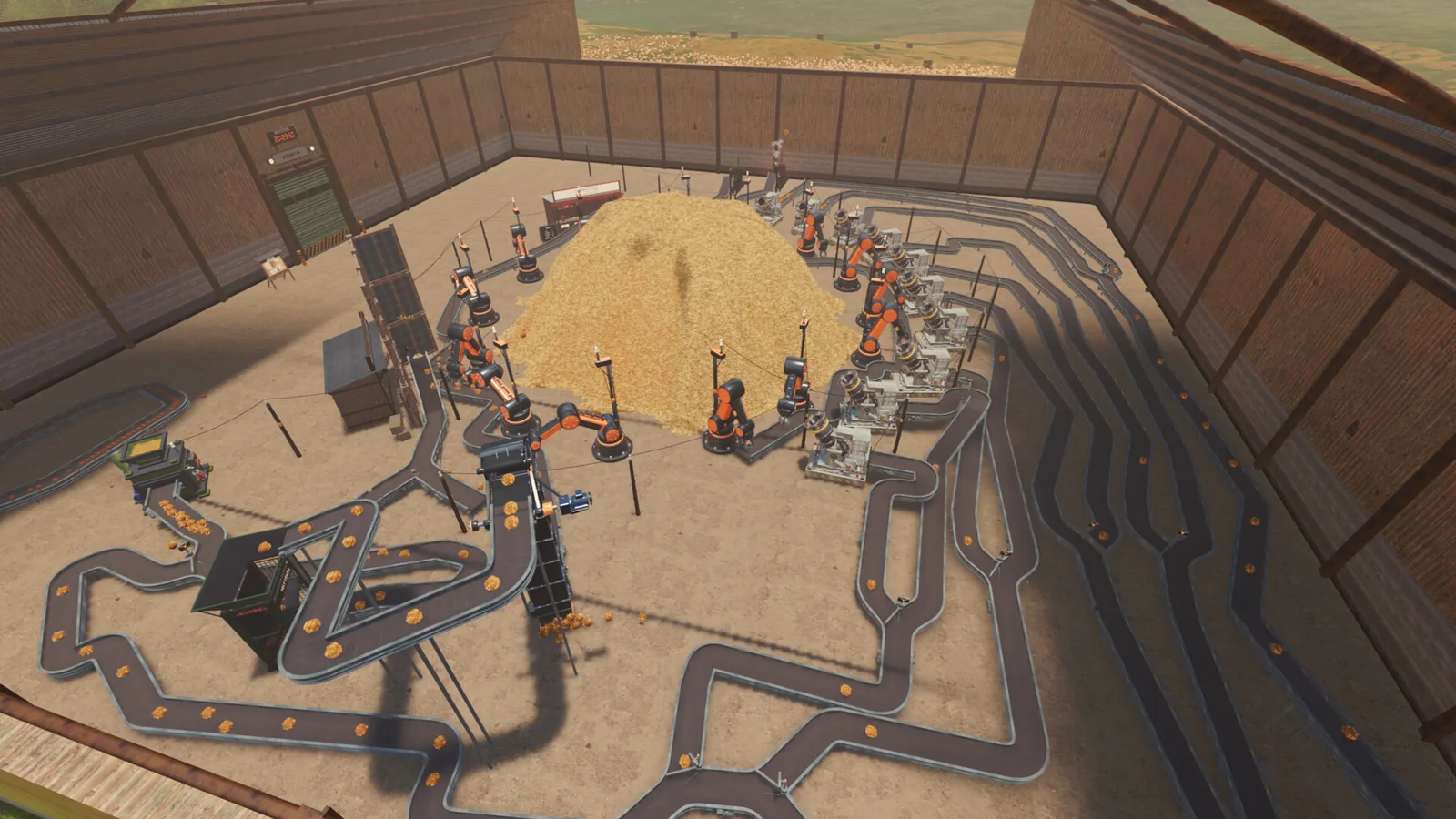
The three stages of automation
Stage 1: Manual
You dig, carry and sell. Every machine is a distraction. The only upgrades worth buying are the ones that reduce the walk or increase carry capacity. This stage ends when you can produce more hay than you can sell in one trip.
Stage 2: Semi-automatic
You still dig, but a belt or machine handles part of the route. A conveyor takes hay from the pile to a baler, or from the baler to the sell point. You keep digging because the pile is the source; the machine removes the carrying.
This is the most important stage to get right. It is where you learn whether your layout has a bottleneck. A semi-automatic line should be short, visible and easy to fix. If you cannot see the whole line from one spot, it is already too complicated.
Stage 3: Full automation
Robots, drones and robotic arms take over part of the digging or handling. The store lists these as automation tools, but it does not publish their unlock order or limits. Full automation is the goal, not the starting point. Do not buy a robot before you have a line worth automating.
What to automate first
The first automation should remove the longest manual step. In most factory games, that is transport, not digging. You can dig quickly; you cannot be in two places at once.
A sensible first line:
- Pickup point at the pile.
- Short belt to a baler or sell point.
- Output into the sell interaction or a storage buffer.
- Power connected and switched on.
- One test load before you expand.
Do not build the whole factory at once. Build one segment, watch it run for a full cycle, and fix the first bottleneck. Then add the next segment.
Belt layout principles
Keep the main line straight. A straight belt is easy to see, easy to extend and easy to debug. Corners are fine, but every corner is a place where items can jam or spacing changes.
Put machines on the line, not beside it. A machine that needs manual feeding is not automated. If the belt cannot feed it, the line is broken.
Leave a gap for walking. You will need to cross the factory. A belt wall that traps you is a design bug.
Build in one direction. A line that weaves back on itself looks compact but is hard to diagnose. Start with a spine and add branches.
Do not mix products without a sorter. If two product types share a belt, you need a sorting machine or a filter. Otherwise the downstream machine receives the wrong input and stops.
Use the shortest belt that works. Longer belts are not more automated; they are more queue. Throughput is set by the slowest machine, not the fastest belt.
The conveyor guide goes deeper on direction, reversing and enclosed belts.
The bottleneck method
Every factory has one bottleneck at a time. Find it by looking at where material accumulates:
- Pile is full, belt is empty: the pickup or digging rate is the bottleneck.
- Belt is full, machine is empty: the belt is not connected or the machine is not powered.
- Machine input is full, output is empty: the machine is processing slower than the input.
- Machine output is full, sell point is empty: the output belt or sell interaction is the bottleneck.
- Everything is full: you are producing more than you can sell. Add demand or process into a higher-value product.
Fix the bottleneck, then look again. The bottleneck moves. That is the game.
Power and pipes
The store lists power and pipes as part of the automation set. The details are not published, but the design implications are standard:
- Power needs a source and a connection. A machine that looks built but does not run is usually unpowered.
- Pipes are for fluids or gases, not boxes. If a product is a solid, it probably moves on a belt.
- Do not bury connections. Leave access to power and pipe joints. You will need to reconnect them after a rebuild.
- Check the whole chain, not just the machine. A powered machine with an unpowered sorter is still a stopped line.
If the game shows a power overlay, use it. If it does not, follow the cable or pipe visually from source to machine before assuming a machine is broken.
Robots, drones and arms
The store lists robotic arms, robots and drones. Those words imply different jobs:
- Robotic arms likely handle pick-and-place or machine tending.
- Robots likely move around the factory or perform tasks in the pile.
- Drones likely cover area tasks or transport.
The exact behavior is not confirmed. Do not buy a drone expecting it to replace a belt until the game shows you what it does. The safe assumption is that each automation type solves a specific bottleneck, not all of them.
A useful test: buy one unit, give it one job, and watch a full cycle. If it spends most of its time idle, the job is too small. If it is always busy and the line is still backed up, the job is too big for one unit.
When not to automate
Automation is not always the best purchase. Skip it when:
- you do not have a steady surplus of hay
- the machine's input is more expensive than the raw product it replaces
- you are still learning the pile layout and will rebuild soon
- the automation would block the path to a needle
- the power cost exceeds the value of the extra output
A common trap is automating a bad route. If the manual route is inefficient, a belt makes the inefficiency faster. Fix the route first, then automate it.
A sample factory plan
This is a structural plan, not a build guide with coordinates:
Section A — intake. The pile edge, a pickup point and a short belt. Keep it open so you can dig into the pile without dismantling the line.
Section B — primary processing. A baler or first-stage machine. Put it close to the intake to keep the belt short.
Section C — output. A sell point or storage buffer. If the product is going to a second machine, leave room for the next stage.
Section D — power. A dedicated area with access. Do not route power cables through the walking path.
Section E — expansion. Empty floor space for the next machine. Leave it empty on purpose. A factory with no expansion space becomes a demolition project.
Build A and C first, then B, then D. Test after each section.
Related pages
Sources
Steam store page for App ID 5160800, public demo, and Needless Games' Steam news, checked November 2, 2026. The automation equipment list is from the store. Specific throughput, power draw, unlock order and robot behavior are not published and are not asserted here.
Related Find The Needle Guides
A Steam wiki for Find The Needle by Needless Games: the six-million-strand haystack, 24 needles, money loop and factory automation for the 2026 EA launch.
Find The Needle has no Steam Achievements listed as of November 2, 2026. What that means, likely milestones, and how to prepare without fake unlock lists.
A practical opening route for Find The Needle on Steam: what to dig, when to sell, which upgrades to buy first, and the mistakes that stall new factories.
How conveyors work in Find The Needle: placing a line, changing direction, reversing and enclosing belts, plus the layout mistakes that stop a factory.
How to install the free Find The Needle demo, what the Steam demo build includes, what it leaves out, and whether progress carries into Early Access.
Find The Needle playtime estimates: 7–10 hours on the Standard pile, 30+ hours on Mountain. Plus what is known about the ending and 24-needle completion.
More Find The Needle Guides
Answers to the most common Find The Needle questions: release date, price, demo, Early Access, multiplayer, Steam Deck, needles, playtime and mods.
Every hay product listed for Find The Needle — pulp, bales, eco bricks, paper, pellets, bioplastic and carbon fibre — and how to decide what to process first.
A guide to Find The Needle's 300+ upgrade tech tree and machine tiers: what to unlock first, how the five production stages fit together, and what to skip.
How to make money in Find The Needle: raw hay vs processed goods, delivery orders, reinvestment order, and why there is no universal best money farm yet.
Find The Needle is single-player only on Steam, with no co-op, no multiplayer and no Workshop support listed. Here is what the tags mean and how mods may work.
Find The Needle has 24 needles total, per the Steam store. How the hunt works, how to search efficiently, and why there is no public location list.
Find The Needle's Steam price was not announced as of November 2, 2026. Here is how to check it, what Early Access includes, and why the demo matters.
Find The Needle releases on Steam Early Access on November 6, 2026. Here is what is confirmed, what is not, and what to check on launch day.