
Find The Needle Best Money Maker: V13 and V14 Numbers
The best money maker in Find The Needle is processed hay sold through orders. Official V13 and V14.1 numbers show which chain pays at each stage.
The best money maker in Find The Needle is not one product. It is the highest-value chain your current stage can feed continuously, sold through orders whenever an order is available. Since the V13 patch on November 7, 2026, orders pay exactly what the goods would sell for, processed goods received much larger price buffs than raw hay, and order requirements dropped by roughly 40%. That combination changed the answer from "sell whatever is convenient" to "process everything you can and load the truck."
This page uses the developer's own V13 and V14.1 patch numbers. It does not invent dollar-per-unit prices, because Needless Games has not published the base sale price of each product.
All numbers below are from the official Steam announcements for V13 and V14.1, checked November 8, 2026. The game is in Early Access and the developer says it will keep balancing almost daily. Recheck the in-game price board after each patch.
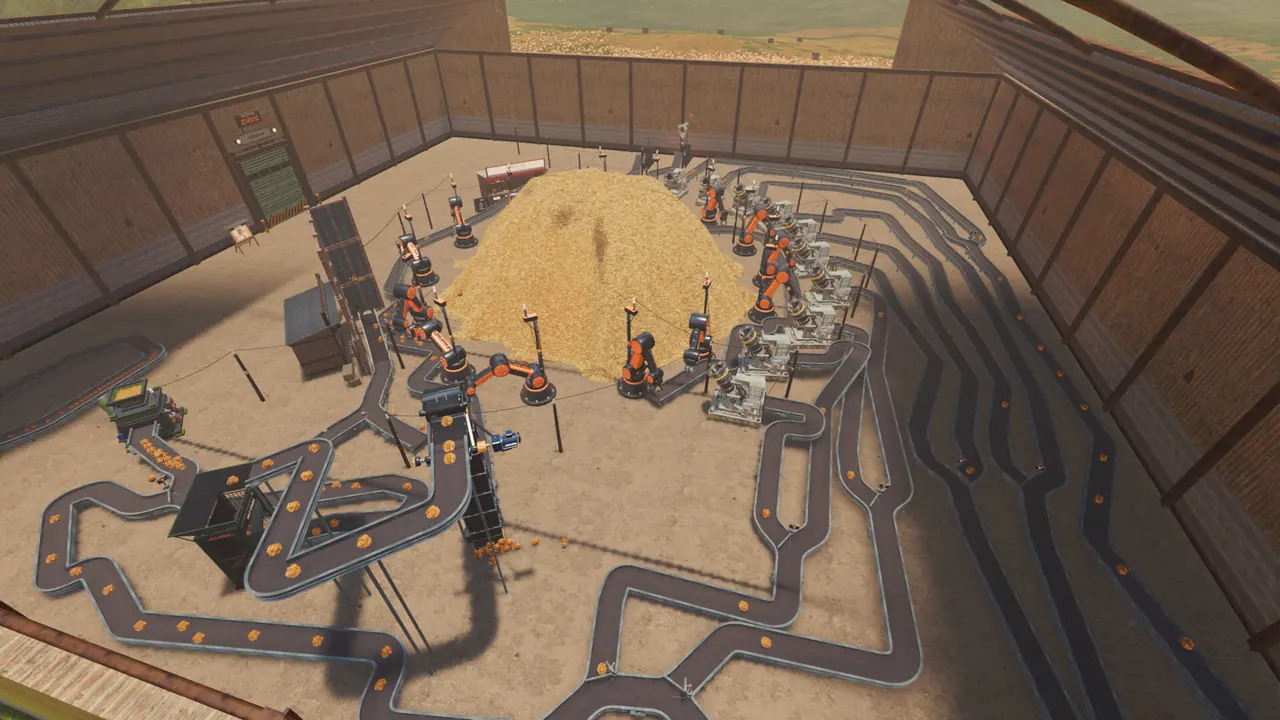
The short answer
- Early game: wrapped bales and straw panels. The first compressor and its plans are free, and the Panel Press now costs $400 instead of $800.
- Mid game: eco bricks, rods, and gears. These are the Stage 2 products that open with the Garden Centre.
- Late game: pulp, paper, then sugar and bioplastic, then fibre and carbon. Each stage adds a longer chain and a bigger buyer.
- Always: fulfil orders. They now pay the goods' sale value, so loading the truck is never worse than selling on the open market.
- Do not expect a published price table. The patch notes give percentages and order quantities, not base prices.
What V13 changed
V13 is the patch that made processing worthwhile. Before it, many players reported that orders felt like a grind and money ran out too fast. The developer responded with a broad economy pass:
| Change | Official number |
|---|---|
| Raw hay sale price | +25% |
| Bales and crafted goods | about +69% to +70% |
| Stage 1 buyer demand | 40 wrapped bales and 8 panels per minute |
| Panel Press price | $400, down from $800 |
| Platform price | $5 per square metre, down from $10 |
| Glass price | $8 |
| Loose hay buyer cap | full price up to 6,000 strands per minute |
| Order payout | equal to the goods' sale value |
| Order quantities | about 40% lower |
| First compressor and plans | free |
The exact order reductions are worth memorising because they tell you how much stock to keep:
| Order | New requirement | Old requirement |
|---|---|---|
| Straw Panels | 25 | 40 |
| Wrapped Bales | 70 | 120 |
| The Dairy | 200 bales and 200 wrapped bales | 480 and 520 |
| Eco Bricks | 300 | 480 |
| Rods and Gears | 120 and 40 | 190 and 70 |
| Pulp | 325 | 540 |
| Paper | 115 | 195 |
The first Bales order still asks for 20 and still needs the same needles. That exception matters if you are restarting and expect every early order to be smaller.
Why processed goods beat raw hay
Raw hay is still useful. Loose hay now has its own buyers who pay full price up to 6,000 strands per minute, and the 25% base increase means early digging pays more than it did at launch. But the processed side rose by roughly 69–70%, so the gap between raw and processed widened.
There is a second reason to process: belts and machines let you keep digging while goods sell. Raw hay requires you to stop digging and carry the hay to a buyer. A finished product can be routed into a Depot and picked up by the order system. The value per hour comes from uptime as much as from price per unit.
The trade-off is complexity. A longer chain has more machines, more power draw, and more places for a belt to back up. V14.1 fixed several of those failure points, including machines eating items, items falling off the end of a belt, and scrap falling off the Smelter's belt. If you tried a big chain before V14.1 and gave up, it is worth retrying.
Stage-by-stage money makers
The Early Access build has five stages and twenty orders. Each stage ends with a big customer, and signing that order opens the next stage. The stage structure is the most reliable guide to what you should be selling.
Stage 1: bales and panels
Stage 1 ends with The Dairy. Your money products are wrapped bales and straw panels. The Panel Press squeezes four bales into one Straw Panel, so the chain is short and easy to observe.
Build the first compressor as soon as the order book gives it to you; it is free. Use the three free speed levels on the belt, arm, compressor, and wrapper before spending on anything else. The Stage 1 buyer wants 40 wrapped bales and 8 panels per minute, which is a rate target rather than a one-off delivery.
Stage 2: bricks, rods, and gears
Stage 2 ends with The Garden Centre. The new products are eco bricks, hay rods, and gear sets. These chains need more machines and more power, but the order quantities are lower than the launch values, and every order pays market value.
This is the point where a Depot becomes useful. V13 added TAKE ONE and TAKE MAX for manual withdrawals, EMPTY OUT to send stock back to the belt, and a Shelf Limits card for $600. V14.1 made Depots cost only money: the first is free with the Panel Press, then $750, $1,130, $1,690, and up.
Stage 3: pulp and paper
Stage 3 ends with The Paper Merchant. Pulp and paper are the first products that feel like a real production line rather than a single conversion. The order cuts are large here: Pulp fell from 540 to 325, and Paper from 195 to 115.
Do not build the full line before you have the power budget. A machine that stops for SHORT OF POWER is worse than no machine, because it holds stock and blocks the belt. The V13 UI now shows SHORT OF POWER directly on the machine.
Stage 4: sugar and bioplastic
Stage 4 ends with The Builders' Merchant. Sugar sacks and bioplastic sheets require the Sugar Cooker and the Bioplastic Reactor. These are multi-input recipes, so belt layout matters more than raw machine count.
V14.1 made level 5 of the arm, compressor, and wrapper unlock sooner with Rods and Gears, and belt level 5 unlock with Eco Bricks. That means the upgrades you need for a Stage 4 line arrive earlier than they did at launch.
Stage 5: fibre and carbon
Stage 5 ends with The Engineering Works. White fibre and carbon booms are the final chain, and the Skyline Crane is the ultimate digger. Driving the crane yourself now digs up to twice as fast as AUTO DIG, which makes manual digging a real option again.
At this stage, the constraint is usually not demand but throughput. The big orders no longer wait for needles on Big, Huge, The Mountain, and MOUNT HAYVEREST, so you can push production without pausing to hunt. Small and Standard still gate those orders on needles.
Orders versus open-market selling
Before V13, an order could pay less than the goods were worth, so skipping it was sometimes correct. That is no longer true. Every order now pays what its goods would sell for. Loading the truck is never worse than selling, and it advances the stage.
The practical rule is:
- Keep producing the current stage's product.
- Fulfil every order you can complete.
- Sell only the surplus that no order wants.
- Spend the money on the next bottleneck, not on cosmetic expansion.
Orders also reveal what the next stage needs. If an order asks for a product you cannot make, that is the machine to unlock next.
What the patch notes still do not tell you
The V13 and V14.1 notes give percentages, order quantities, and specific machine prices. They do not give the base sale price of each product, the exact recipe ratios for every chain, or a dollar-per-minute ranking. Any page that claims "X makes $Y per hour" without those numbers is guessing.
Use the in-game price board. V14.1 added a useful change: the board lists products you can make but have not sold yet, so you can compare before committing a line. That is a better source than a static guide, because the developer is still balancing.
FAQ
What is the best money maker in Find The Needle?
Processed hay sold through orders. At each stage, make the product that stage introduced: bales and panels in Stage 1, bricks/rods/gears in Stage 2, pulp/paper in Stage 3, sugar/bioplastic in Stage 4, and fibre/carbon in Stage 5. Orders now pay the goods' sale value.
Is raw hay still worth selling?
Yes, especially early. Loose hay has its own buyers who pay full price up to 6,000 strands per minute, and V13 raised its price by 25%. Switch to processing when your digging outpaces your selling trips or when an order demands a processed good.
Did V13 make orders worth doing?
Yes. Every order now pays what its goods would sell for, and order quantities dropped by about 40%. Before V13, an order could be worse than selling directly.
How much does the Panel Press cost now?
$400, down from $800 in V13. The first compressor and its plans are free.
Are these prices permanent?
No. Find The Needle is in Early Access and the developer has said it will keep balancing. Treat the numbers as the V14.1 state, not a permanent economy.
What to read next
- the full money guide — the structural version, without patch numbers
- hay products explained — what each product is
- machines and tech tree — unlock order
- automation and belts — keeping the line fed
Sources
Official source: Update V13: Balancing Every Day ↗ and Update V14.1 ↗ — Needless Games, November 7, 2026.
Related Find The Needle Guides
How to make money in Find The Needle: raw hay vs processed goods, delivery orders, reinvestment order, and why there is no universal best money farm yet.
A Steam wiki for Find The Needle by Needless Games: the six-million-strand haystack, 24 needles, money loop and factory automation for the 2026 EA launch.
Find The Needle now has 60 Steam Achievements. Here are the highlighted unlocks, what they suggest about progression and how to plan a completion run.
A structural guide to automating Find The Needle: manual vs semi-auto vs full-auto, belt layout, machine order, power and the bottlenecks that stall a factory.
A practical opening route for Find The Needle on Steam: what to dig, when to sell, which upgrades to buy first, and the mistakes that stall new factories.
Find The Needle has no codes, no cheat console and no redeem page. Here is what actually unlocks content, and how to spot fake code and free-key sites.
More Find The Needle Guides
How conveyors work in Find The Needle: placing a line, changing direction, reversing and enclosing belts, plus the layout mistakes that stop a factory.
How to install the free Find The Needle demo, what the Steam demo build includes, what it leaves out, and whether progress carries into Early Access.
Find The Needle playtime estimates: 7–10 hours on the Standard pile, 30+ hours on Mountain. Plus what is known about the ending and 24-needle completion.
Answers to the most common Find The Needle questions: release date, price, demo, Early Access, multiplayer, Steam Deck, needles, playtime and mods.
Every hay product listed for Find The Needle — pulp, bales, eco bricks, paper, pellets, bioplastic and carbon fibre — and how to decide what to process first.
A guide to Find The Needle's 300+ upgrade tech tree and machine tiers: what to unlock first, how the five production stages fit together, and what to skip.
Find The Needle is single-player only on Steam, with no co-op, no multiplayer and no Workshop support listed. Here is what the tags mean and how mods may work.
Find The Needle has 24 needles total, per the Steam store. How the hunt works, how to search efficiently, and why there is no public location list.