
Find The Needle Walkthrough: Five Stages, Twenty Orders
A stage-by-stage Find The Needle walkthrough: five stage customers, the machines they unlock, needle gates, and the fastest route out of the early grind.
Find The Needle does not have missions in the usual sense. Its walkthrough is a chain of twenty delivery orders spread across five stages. Each stage ends with a big customer, and signing that customer's order opens the next stage: new machines, new products, and a bigger digger. The demo had seven orders; the Early Access build has twenty.
This walkthrough follows that structure. It tells you what to build, what to sell, and where the needle gates sit, without inventing order names or prices the developer has not published.
Based on the official Early Access changelog and the V13/V14.1 patch notes, checked November 8, 2026. The game is in Early Access and balance changes frequently. Order quantities and machine costs below reflect V14.1.
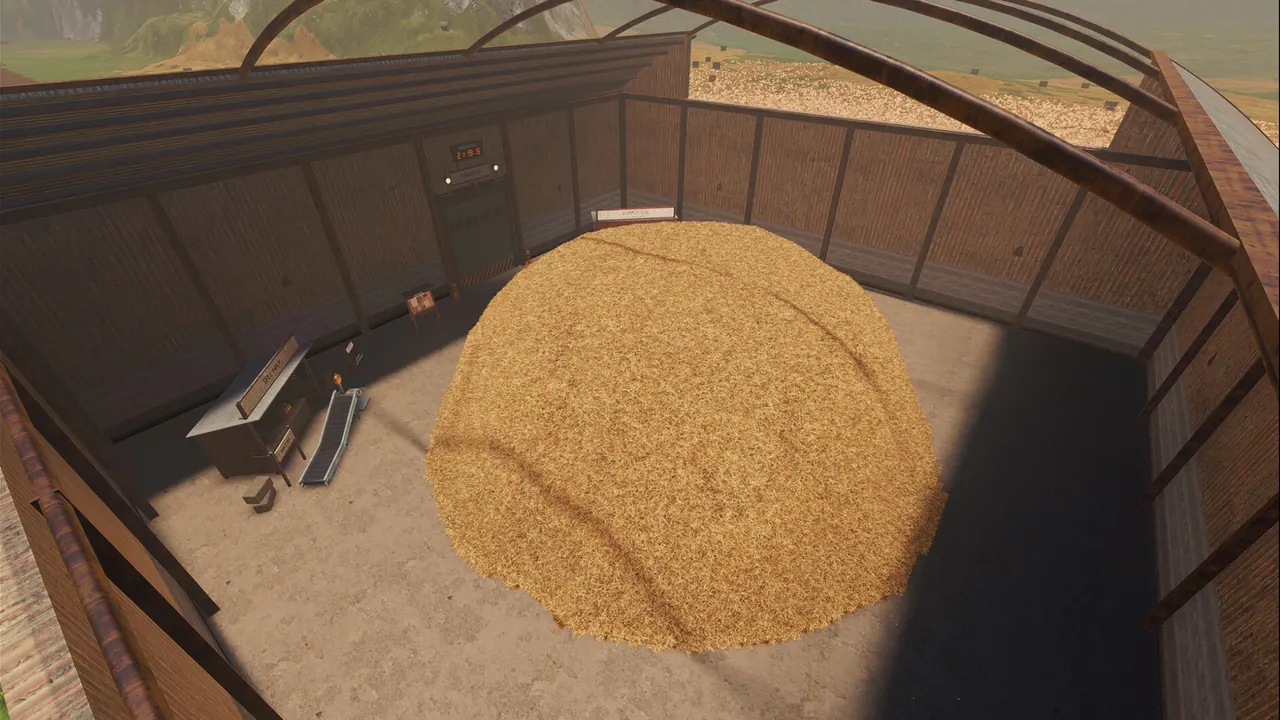
The five-stage structure
| Stage | Main products | Ends with |
|---|---|---|
| 1 | Bales and panels | The Dairy |
| 2 | Bricks, rods, and gears | The Garden Centre |
| 3 | Pulp, paper, and assembly | The Paper Merchant |
| 4 | Sugar and bioplastic | The Builders' Merchant |
| 5 | Fibre, carbon, and the ultimate digger | The Engineering Works |
Signing an order hands you everything it opens, with a reveal animation. A big order waits until your needle cabinet holds enough needles, so the hunt and the factory pull on each other. That is the core pacing device: you cannot simply out-produce a stage gate.
Stage 1: bales and panels
You start with a pile and a shovel. The first job is to dig loose hay and sell enough of it to buy the first tools. Loose hay now has its own buyers who pay full price up to 6,000 strands per minute, so early digging is a legitimate income source rather than a waste.
The first compressor and its plans are free with the order book. Build it as soon as you can, then start pressing bales. The Panel Press costs $400 after V13, down from $800, and squeezes four bales into one Straw Panel. Platforms are $5 per square metre, down from $10, and glass is $8, so basic expansion is cheaper than it was at launch.
The Stage 1 buyer wants 40 wrapped bales and 8 panels per minute. That is a rate, not a one-time delivery. If your line cannot sustain it, fix the bottleneck before adding machines: a full belt and an empty machine mean the upstream is too fast; an empty belt and a full machine mean the downstream is too slow.
Use the three free speed levels on the belt, arm, compressor, and wrapper before spending on upgrades. V13 added a third free level, and V14.1 moved level 5 of the arm, compressor, and wrapper earlier, to Rods and Gears.
Stage 2: bricks, rods, and gears
The Garden Centre ends Stage 2. The new products are eco bricks, hay rods, and gear sets, and the pile now contains metal scrap: over twenty kinds of iron and copper scrap, including horseshoes and copper elbows.
Scrap is the new failure mode. It rides your belts, can be sorted, and sells, but if it enters a hay machine it jams. The machine glows and a banner tells you which one. Build a sorter or route scrap to the Smelter, which melts it into iron and copper ingots. Generators burn scrap instead of jamming on it, so scrap is both a nuisance and a power source.
The V14.1 patch fixed several belt bugs that mattered here: machines eating items, items running past a short intake and disappearing, and scrap falling off the end of the Smelter's belt. If you bounced off the game before that patch, Stage 2 is smoother now.
Order quantities are lower than at launch. Eco Bricks ask for 300 instead of 480, and Rods and Gears ask for 120 and 40 instead of 190 and 70. Every order also pays what its goods would sell for, so there is no penalty for loading the truck.
Stage 3: pulp and paper
The Paper Merchant ends Stage 3. Pulp and paper are the first genuinely multi-step products, and the order cuts are large: Pulp fell from 540 to 325, and Paper from 195 to 115.
This is where power becomes the limiting factor. A machine that shows SHORT OF POWER holds stock and blocks the belt, which is worse than not building it. The Biogas Digester turns Wrapped Bales into power, and V13 added a warning when it burns bales faster than they arrive. Read that warning before expanding.
The Depot becomes useful in this stage. V13 added manual withdrawals, an EMPTY OUT option, and a Shelf Limits card for $600. V14.1 made Depots cost only money: the first is free with the Panel Press, then $750, $1,130, $1,690, and up. A Depot with no belt after it drops what it cannot hold instead of selling it, so always give it an output.
Stage 4: sugar and bioplastic
The Builders' Merchant ends Stage 4. Sugar sacks and bioplastic sheets need the Sugar Cooker and the Bioplastic Reactor, and both are multi-input recipes. Belt layout matters more than machine count: if one input arrives faster than the other, the recipe stalls.
The practical fix is a small buffer before each multi-input machine, not a bigger upstream. Use splitters with named routes, and keep the routes short. V14.1 also made Scan Batch Size and Scan Cycle Speed levels 1–3 available without waiting for orders, so you can scan the pile properly before committing to a layout.
At this point you should be fulfilling every order rather than selling surplus. Orders advance the stage and pay market value. Surplus is what you sell when no order wants it.
Stage 5: fibre and carbon
The Engineering Works ends Stage 5 and the current Early Access story. White Fibre and Carbon Booms are the final chain: Fibre Spinner melts bioplastic into White Fibre, and the Carbon Kiln bakes it black. Composite Plates come from the Assembler.
The Skyline Crane is the ultimate digger. You can set its zone, or take the controls and drive it yourself; manual driving now digs up to twice as fast as AUTO DIG. That makes active play competitive with automation at the end of the game, which is a deliberate design choice rather than an oversight.
Big orders on Big, Huge, The Mountain, and MOUNT HAYVEREST no longer wait for needles after V14.1. Small and Standard still do. If you are chasing the ending, the larger pile types remove a gate; if you are chasing the collection, the smaller piles keep the needle loop relevant.
Where the needles fit
There are 24 needles. They give bonuses that reach every machine, including Big Depot, Deep Well, and Fired Up. The needle cabinet shows your progress, and big orders wait until the cabinet holds enough needles.
Do not treat needle hunting as a separate activity. Sweep a lane with the detector while your factory runs, and bank the needles before a big order. The needles guide explains the search pattern; this walkthrough only covers when the gates appear.
Efficiency checklist
- Spend the three free speed levels before buying upgrades.
- Keep one pile for the whole run; the game is balanced around a single giant haystack.
- Use blueprints in three sizes to copy a working line instead of rebuilding it.
- Dismantle up to 50 buildings at once when you redo a layout.
- Overclock machines from 1% to 100% when you need throughput, and turn it back down when power is tight.
- Fix jams at the source. A machine that eats scrap is not a belt problem.
FAQ
How many stages are in Find The Needle?
Five stages and twenty orders in the Early Access build. The demo had seven orders. Each stage ends with a big customer: The Dairy, The Garden Centre, The Paper Merchant, The Builders' Merchant, and The Engineering Works.
Do I need all 24 needles to finish?
Big orders wait until your cabinet holds enough needles, so needles gate progression. The exact number required per order is not published in the patch notes. The collection also grants machine bonuses, so hunting is useful even when it is not blocking you.
Can I play the whole game on one pile?
Yes. The developer says one pile lasts the whole game, all the way to the ending. Different pile sizes change the difficulty and the order gates.
What should I build first?
The first compressor, which is free with the order book. Then a Panel Press at $400, and the three free speed levels on your belt and machines. Do not buy cosmetic expansion before the Stage 1 rate target is stable.
What to read next
- beginner guide — the first thirty minutes
- machines and tech tree — what each machine does
- best money maker — V13/V14 economics
- all 24 needles — the collection loop
Sources
Official source: The Early Access game is here! CHANGELOG ↗ — Needless Games, November 6, 2026.
Related Find The Needle Guides
A Steam wiki for Find The Needle by Needless Games: the six-million-strand haystack, 24 needles, money loop and factory automation for the 2026 EA launch.
Find The Needle now has 60 Steam Achievements. Here are the highlighted unlocks, what they suggest about progression and how to plan a completion run.
A structural guide to automating Find The Needle: manual vs semi-auto vs full-auto, belt layout, machine order, power and the bottlenecks that stall a factory.
A practical opening route for Find The Needle on Steam: what to dig, when to sell, which upgrades to buy first, and the mistakes that stall new factories.
The best money maker in Find The Needle is processed hay sold through orders. Official V13 and V14.1 numbers show which chain pays at each stage.
Find The Needle has no codes, no cheat console and no redeem page. Here is what actually unlocks content, and how to spot fake code and free-key sites.
More Find The Needle Guides
How conveyors work in Find The Needle: placing a line, changing direction, reversing and enclosing belts, plus the layout mistakes that stop a factory.
How to install the free Find The Needle demo, what the Steam demo build includes, what it leaves out, and whether progress carries into Early Access.
Find The Needle playtime estimates: 7–10 hours on the Standard pile, 30+ hours on Mountain. Plus what is known about the ending and 24-needle completion.
Answers to the most common Find The Needle questions: release date, price, demo, Early Access, multiplayer, Steam Deck, needles, playtime and mods.
Every hay product listed for Find The Needle — pulp, bales, eco bricks, paper, pellets, bioplastic and carbon fibre — and how to decide what to process first.
A guide to Find The Needle's 300+ upgrade tech tree and machine tiers: what to unlock first, how the five production stages fit together, and what to skip.
How to make money in Find The Needle: raw hay vs processed goods, delivery orders, reinvestment order, and why there is no universal best money farm yet.
Find The Needle is single-player only on Steam, with no co-op, no multiplayer and no Workshop support listed. Here is what the tags mean and how mods may work.